


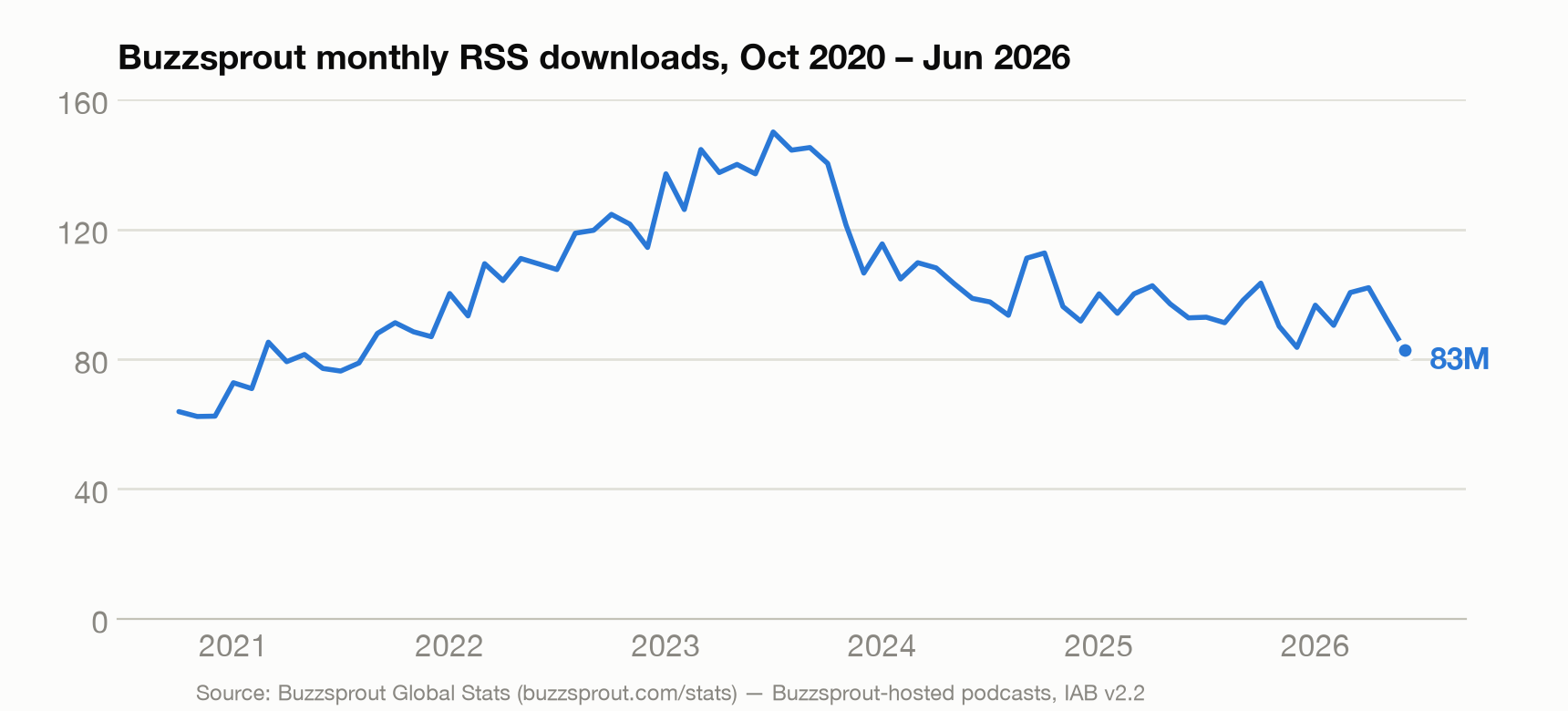
Independent podcast apps are not growing as a category. This is not a particular secret, but perhaps you haven’t seen it stated explicitly. It’s the sort of thing that has to be inferred, but there’s plenty of available data1 if you look for it. While the podcasting sector has seen growth, this has occurred almost entirely on platforms like YouTube2, and the independent podcast app userbase has mostly just stood still.
You might have a theory that there’s a funnel and growth in podcasts *must* ultimately be good for the apps. Like YouTube and TikTok introduce people to the concept of podcasts via shorter videos, and as certain users become more enthusiastic about a particular creator or the whole concept, they migrate to specialty apps to ensure they never miss an episode. I like this theory. It’s a good story, but I see very little evidence of this happening. Instead, the apps are largely fighting to retain the same cohort of users who have been using podcast apps since ~2015 while the world moves on.
I can’t tell you this with absolute certainty. I have no concrete demographic data on my own podcast app, let alone anyone else’s. It’s a big world, so I’m sure somewhere out there a 21-year-old just downloaded Castro or Pocket Casts for the first time and thinks RSS feeds are awesome (if you are this person, please email me). But every number I can see indicates the userbase is both static and aging. Every new customer I talk to has used some combination of Apple Podcasts, Overcast, Pocket Casts, or Castro for at least the last 5 years if not the last 10. Some podcast apps are definitely doing better than others, and any given app can win users, but we’re all crabs trapped in the same bucket.
One might think that the podcast app incumbents are dinosaurs and an AI-forward podcast app aimed at riding current trends has an opportunity. In reality, no new podcast app seems to be gobbling up any substantial market share3 either. I mean why isn’t something like Snipd moving up in these app rankings? Why hasn’t any app released after 2020 gained any traction at all? That bothers me a lot more than any metric on Castro.
It’s a nice idea that all the “major” players are doing something wrong and there’s a cohort of users waiting to be unlocked. I sincerely hope someone does it, but it hasn’t happened yet. Waves of new podcast listeners may exist, but they aren’t downloading episodes via RSS, no matter how many podcast apps are being vibe-coded.
This is not a happy story I’m telling you, not for anyone who loves podcast apps like I do. Perhaps there are healthy businesses that get very few new users but instead gracefully age with the ones they have. Ferrari maybe? Buddy, smartphone apps are not one of those businesses.
That doesn’t necessarily mean the open podcasting ecosystem is doomed4, but the apps aren’t doing well and there’s no reason to think that’s going to change. I’m also not going to write a 2000 word diatribe on how it’s not a podcast unless there’s an RSS feed. That’s not my point. The world changes. I’m just stating the facts plainly so you have context on how I’m making decisions at Castro.
So I wanted to share some thoughts about podcast apps and what they should be building. This applies to Castro, but it’s not really specific to Castro. It’s certainly not any kind of roadmap or promise. I would rather work on flashy features to capture new users, but, reality being what it is, I have to think about things in terms of both the health of the ecosystem and what will actually help retain existing podcast app users. They’re the only ones I’m going to get.
On Creator Intent
To a creator, the only real thing a podcast app can be said to have over a platform like Spotify or YouTube is disintermediated access to some of their best listeners. By and large podcast apps are just showing exactly what the creator drops in the RSS, and there are vanishingly few places you can get that.
Now most creators aren’t thinking about this in these terms, but some certainly are. Some listeners are as well, and it’s sort of the backbone of the whole medium. Podcast apps basically rely on the trust of the creators to exist.
I think this whole integrity-of-the-feed stuff should be taken really seriously. Not because I personally care about the sanctity of the RSS feed in my soul, but more that it’s the only thing we have. Also, as independent apps slowly become relevant to only a small number of hobbyists, those hobbyists are really going to care about the integrity of the feed. I mean trust me, I know those guys.
This is why I’m uncomfortable with certain changes others are making. Generating chapters and transcripts is explicitly messing with podcast content in a way we normally don’t do, and I worry it runs the risk of compromising the whole enterprise. Creators can provide transcripts and chapters if they wish, but I don’t see how it’s appropriate to do it for them.
In much the same way, I really, really don’t think we want podcast apps removing ads. If we’re just going to put our own generated stuff or remove the ads on your podcast, and we’re 1% of your listeners, which we also won’t give you any visibility into, I mean what are we doing here exactly? Why would a content creator sign up for that deal? I don’t think it’s that hard to imagine major shows not bothering with any of this and only posting directly to YouTube if we aren’t careful.
Perhaps generated transcripts are just table stakes and it’ll be expected everyone will have them, but for now these are not features I’m going to work on. Creator intent is too important. That’s not to say I think we should put our head in the sand and ignore generative AI. On the contrary, there’s probably a lot we could do I haven’t thought of. I just don’t think the juice is worth the squeeze on these specific features.
Private feeds
Paid private feeds are really great for podcast apps. In my mind it’s the best example of the business really working for everyone. The creator has a direct relationship with your customer, and we’re just facilitating a better listening experience that the user has chosen directly. I think we should do more with these. The way they work is messy, and at least on Castro we haven’t put in the time to make them first-class citizens. For instance, there’s very little connection between a public version of a podcast and its private equivalent. So I end up with two The Rest is History feeds and can barely figure out what I’ve listened to unless I slog through both or somehow connect them. It’s also really frustrating that there isn’t an easy way to listen to a public feed in Castro and then just quickly buy the private version for yourself.
I have a little trouble understanding why private feed providers like Patreon, NY Times, Substack, etc. haven’t taken a more active interest in preserving the medium as an ecosystem for just this purpose. Lots of people listen to The Daily, only a fraction of those listen on the NY Times app. If your existing customer is not going to be on your app, wouldn’t you rather they consume an RSS feed you control directly rather than on YouTube? I understand the users have chosen YouTube and Spotify, so companies have chosen them as well, but a little nudging to the open Internet would go a long way. But hey, I’m sure it’ll be fine, the pivot to platform video always works out great, right?
If there’s another boom left in podcast apps, there’s a good chance it will be set off because YouTube did something really evil.
Customers
At least one other thing podcast apps have going for them: their customers are fairly high value, which matters. On the other hand, as listeners they’re mostly anonymous and don’t want to be tracked. They’re difficult to monetize, and they fucking hate seeing ads... so maybe not that high value.
I don’t have any concrete proposals here. This is not something I’ve thought about a ton, but if there are any sacred oxen to be gored in terms of tracking, we should probably find ways to gore them that users will find acceptable. Anything we could do to make the open podcasting ecosystem more legible to creators and advertisers would have to be the correct tradeoff for the health of the ecosystem. Do you want to listen in your favorite app with the knowledge that your favorite podcast has some idea of who you are and can send you relevant ads, or do you want your favorite app to cease to exist? Them’s the breaks.
Video
Video podcasts should be embraced yesterday. There’s absolutely nothing about RSS that demands it be audio-only. Podcasts have never even been audio-only. There’s at least some evidence5 that video time is replacing audio. This is only going to get worse. Video is only going to get more prevalent, and there’s only so much time in the day. If you want to keep the users who are already with you, it’s a lot better if the video watching is happening in your app.
I’m a guy who loves a dumb hill to die on, but anyone still holding out on the only-audio-is-a-podcast hill is bananas. Support video. It’s one of the vanishingly few things that can help arrest decline. Huge shout-out to everyone who has made alternate enclosure happen.
Accessibility features
Mechanically, an aging userbase is going to have increasing need for accessibility support. Things like VoiceOver and larger font support should be prioritized. A well-crafted independent app can agonize over these and incorporate them into the product from day 1. Castro has always taken this seriously and will continue to do so.
Consolidation and shared infrastructure
I mean it’s just obvious there should be fewer of them right? I’m not going to pick which ones have to go, but in a static category with a lowering barrier to entry, you can’t keep dividing the pie and keep anything meaningful. I don’t know how to effect this outcome, but apps that don’t see a long future for themselves should merge into healthier ones or at least on some level share infrastructure. Larger userbases would give apps more leverage and more development resources, which would allow them to build better products and stick around longer.
Audio
Can we do more with audio? We don’t want to compromise creator intent, but it just seems like a lot of things could be done in this space. Castro’s playback code has barely changed over the years, but I’m still often told it sounds better than many competitors. Audio playback is weirdly neglected for an audio medium. There’s no sacred cow that precludes us from making things sound better right? It really feels like we should’ve invested more here.
Be frank with the users
Look, the only way this software will continue to exist is if people work on it or they pay others to work on it. The people who care about using their super special podcast apps are mostly the same people who cared about them five years ago, and there truly aren’t that many of us. That’s why I’m talking to you here now. I appreciate everyone who uses an indie app. You are my people, and you deserve to know where things stand. We’re just deciding what to do with the time we have left, but of course that was always true.
Buzzsprout shows declining downloads, RAJAR MIDAS linked below shows declining listening, Transistor stats show almost every independent app flat to declining in market share. You can put together historical weekly download numbers from Triton Rankers, or you can also trawl through historical Apple and Google Play ranking data. All tell roughly the same story.
https://www.edisonresearch.com/the-infinite-dial-2026/
Credit John Spurlock for compilation and Transistor for the stats
Ultimately, it might mean that, but let’s leave that for a future post
25% of the UK population tune in to podcast episodes in an average week and those listen for around 7.7 hours per person… 111 million hours are listened to in an average week in the Spring 2025 wave to Podcasts.
13% claim to watch podcasts weekly.
25% of the UK population tune in to podcast episodes in an average week and those listen for around 6.4 hours per person… 93 million hours are listened to in an average week in the Spring 2026 wave to Podcasts.
16% claim to watch podcasts weekly.
not sure I understand what you said about transcripts. how is creating them a bad thing? what about accessibility? super curious